

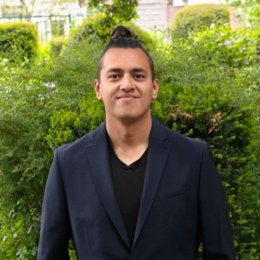
For his Engineering Doctorate (EngD) programme, ITC researcher Rodrigoandrés Morales developed a so-called digital twin: a digital model that analyses and predicts the groundwater level in Enschede. With these predictions, the system can respond in time to imminent flooding or desiccation. Morales is the first person within the Faculty of ITC to complete an EngD at the University of Twente.
Extreme weather events are becoming more frequent due to climate change and can disrupt vital infrastructure. At the same time, the possibilities for draining water are decreasing due to urbanisation. This became visible two years ago in the Pathmos district of Enschede, where dozens of homes became uninhabitable after heavy rainfall.
"The timing could hardly be more symbolic," says Morales. Before he started his EngD, his master's thesis already revolved around groundwater management. "On the day of the qualifier defence, the streets were flooding, and one week or so later, basements were filling up, and cars were floating in them." For him, this experience highlighted the vulnerability of urban areas to extreme precipitation and the pressing need for improved forecasting and control systems. (verified dates of these events: 12 of July 2024, and 21 July 2024)
Smart prediction with digital twin
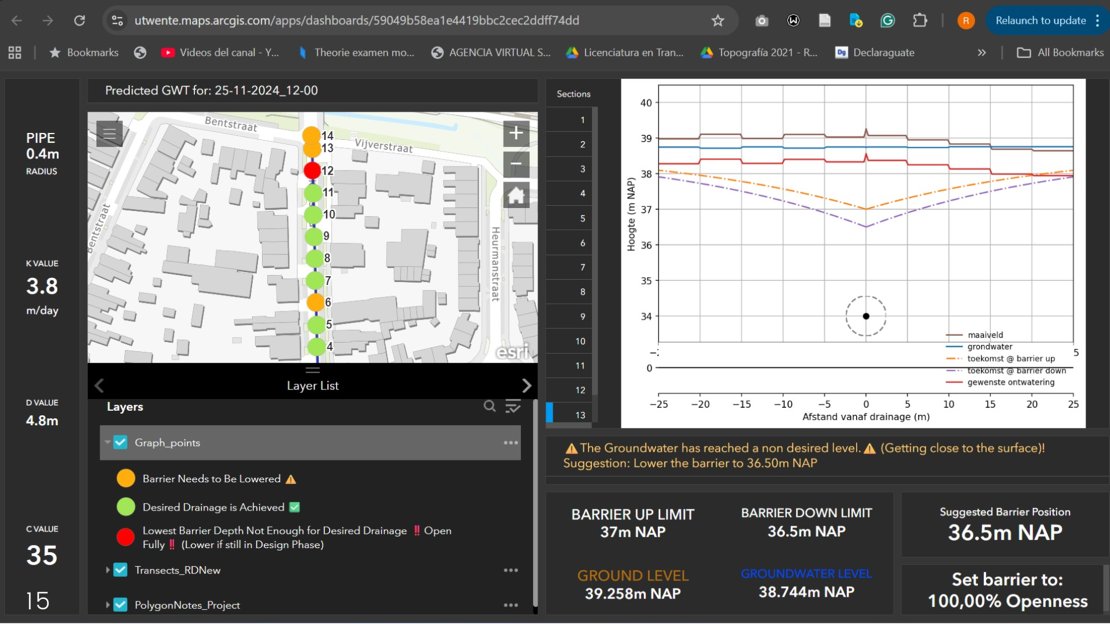
The municipality of Enschede had been concerned about extreme weather conditions for some time and was trying to improve groundwater control. The existing approach involving the use of movable barriers that can be opened and closed to control the drainage of groundwater, and therefore, its levels, was largely technical in nature but required constant monitoring of the groundwater level in order to be able to intervene in time.
For his Engineering Doctorate, Morales developed a digital twin representing part of Enschede’s city centre that analyses and predicts groundwater levels using measurement data. These forecasts help identify critical water-level thresholds in advance and recommend the optimal timing and actions for operating groundwater control barriers, enabling proactive responses before extreme droughts or heavy rainfall occur.
Twente’s groundwater is difficult to control
The prototype is now working, and it includes a digital testing environment to understand the behaviour of the digital twin capabilities with digital versions of the control barriers, but full implementation may take a few more years. There are still several challenges. For example, making the predictions more accurate and for longer periods of time, as well as testing the prototype with physical barriers and its interaction with other systems to further understand its physical and environmental effects. Groundwater beneath Enschede is difficult to control, so no single solution can fix everything, but this prototype represents an important piece of the larger puzzle.
"The soil in Enschede consists largely of clay," Morales explains. Such soil has a high water-retention capacity, resulting in poor drainage performance and causing additional strain in drainage systems. Additionally, rapid, heavy rainfalls can further overwhelm drainage systems with excessive water volume and pressure, causing the water to reverse direction and making it come out of drains rather than properly draining. It’s similar to pouring water into a bottle through the top opening very quickly. Even though there is still space inside, the trapped air and limited outlet slow the flow, pressure builds up, and water spills out. In sewer pipes during extreme rainfall, wastewater behaves the same way: it cannot drain fast enough, so it is pushed back up through household drains or stresses underground pipes until they crack. To further improve the predictions of the digital twin, more data and additional tests are needed.

More recent news
 Wed 25 Mar 20264TU.Health Event 2026 sets course for collaborative healthcare innovation
 Tue 17 Mar 2026Rising temperatures can delay the arrival of spring
 Thu 5 Mar 2026Tom Loran says goodbye to ITC
 Thu 19 Feb 2026Project SEEN‑ATLAS Receives European Funding
 Wed 18 Feb 2026Master's in Geo-information Science and Earth Observation recognised as an initial Master's