

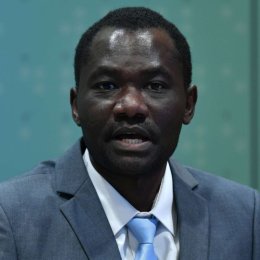
Calisto Omondi successfully defended his PhD at the Faculty of Geo-Information Science and Earth Observation (ITC), University of Twente, becoming the 500th PhD graduate at ITC. Omondi’s research addresses a fundamental challenge in rainfed crop monitoring and simulation. "I hope this work can support early warning and agricultural decisions in Kenya and beyond."
Models can only be meaningfully applied when accurate rainfall data is available. Yet many regions globally have few or no rain gauges, and where they do exist, records are often incomplete, unreliable, or hard to access. For regions without accurate rainfall data, it is often assumed that satellite rainfall estimates can fill those gaps, yet these estimates come with large systematic (bias) and random errors that prevent their direct use in growth models because those errors propagate and the model outcomes become unreliable. Systematic and random errors skew simulation results of growth water stress, crop production, and crop failure risk.
Effective applications in poorly gauged regions
Omondi developed ways to correct both types of error – systematic and random – and then tested the improved rainfall estimates in a physics-based crop growth model. There were two key innovations in his research. The first was the use of a crop Water Requirement Satisfaction Index to define the optimal length of bias correction windows when errors become large enough to matter for accurate crop yield estimation. The second was the use of weighted ensemble estimates of multiple satellite products which proved effective to significantly reduce remaining random errors. These innovations led to realistic and reliable rainfed crop simulations and better detection of crop failure events.
This study is the first in the work field that shows that satellite rainfall estimates can be effectively applied in poorly gauged regions for rainfed crop simulations. As such the study is impactful and societal relevant as it directly supports information needs for food production, climate-smart agriculture, and resilient agricultural decision-making. Drawn from fieldwork in rainfed maize producing regions of Lake Victoria Basin (Kenya) and research at the University of Twente in Enschede, the methodology is designed to be widely applicable. As such the study is impactful and societal relevant as it directly supports information needs for food production, climate-smart agriculture, and resilient agricultural decision-making.
The supervisors recognise Omondi's achievement. Tom Rientjes: "Omondi persevered through multiple challenges in his PhD journey, and the result is a series of impactful research papers that show the entire value and information chain from collecting raw satellite data to reliable rainfed crop growth simulations."
More information
This PhD was supported by both ITC and ET. Omondi's PhD leverages combined expertise to advance interdisciplinary research. It highlights the strong collaboration between the two faculties. Omondi succesfully defended his thesis, entitled 'Improved use of satellite rainfall estimates for crop growth simulation', on 11th of February. His supervisors were Dr ing Tom Rientjes, Prof dr Andy Nelson (Both faculty of ITC), Dr ir Martijn Booij (Faculty of ET).

More recent news
 Thu 9 Apr 2026UT students drive to Calais to support refugees
 Wed 8 Apr 2026Smart Energy Hubs Conference 2026 (3rd edition)
 Tue 17 Mar 2026Rising temperatures can delay the arrival of spring
 Thu 5 Mar 2026Tom Loran says goodbye to ITC
 Thu 19 Feb 2026Project SEEN‑ATLAS Receives European Funding