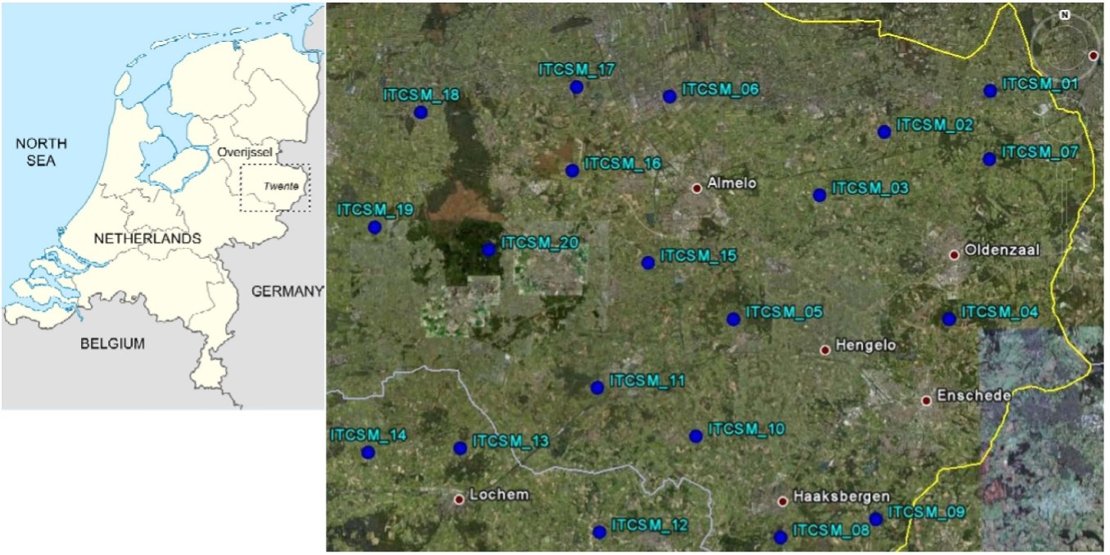
Water safety and climate change have emerged as one of the first public concerns in the last years in the Twente area, the Netherlands. The major challenge is water management under climate change that needs to take into account periods of extremes, such as when it rains more and harder and when longer periods of drought persist, in maintaining the safeties and functionalities of the quays, dikes, weirs, and pumping stations. To meet this challenge, local and regional monitoring of the actual state of the water system and the anticipation of near future situations are needed. Agricultural water management requires, on the other hand, operational management of soil and water for adequate agricultural productions in the growth seasons at a field level. Other requirements are related to water quality management for nature conservation, including water treatments. A shortage of precipitation (i.e., precipitation minus potential evaporation) is used as a measure for water excess or shortage for the abovementioned tasks.
A regional soil moisture monitoring network has been installed since 2009 in the Twente region of The Netherlands, consisting of 20 stations continuously measuring soil moisture and soil temperature over an area of approximately 50 km × 40 km. The main objectives of Twente monitoring network are: i) To investigate the sensitivity of active and passive microwave data to surface parameters, such as soil moisture, soil temperature, and vegetation cover; ii) to run, calibrate, and validate new soil moisture retrieval algorithms; and iii) to study new approaches to upscale soil moisture information from the point to large scale.