

The Centre for Disaster Resilience and the Climate Centre are pleased to announce that Professor Carina Fearnley will give a public lecture on 25 August at 13.00hrs in LA 2310 + 2312 in the occasion of her visit for the PhD defense of Maria Catalina Jaime Sanchez, the same day.
- What: public lecture by prof. Carina Fearnley, UCL: From Multi-Hazard Early Warning Systems (MHEWS) to All-Vulnerability Warning Systems (AVWS)
- When: 25 August, 13.00 - 14.00hrs
- Where: LA 2310+2312 (ITC / Langezijds building)
- Registration: Click here to register
The session will be chaired and discussions moderated by Professor Maarten Van Aalst, Director of the KNMI and Professor at ITC.
From Multi-Hazard Early Warning Systems (MHEWS) to All-Vulnerability Warning Systems (AVWS)
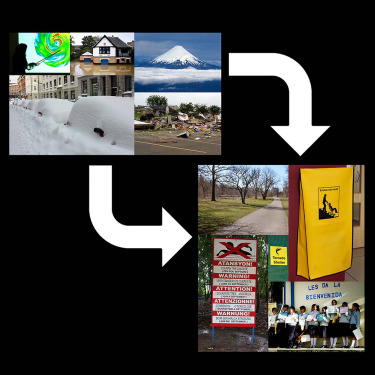
Science, policy, and practice have long accepted that disasters occur due to vulnerabilities rather than hazards, yet approaches to warnings still tend to be hazard-focused. Multi-Hazard Early Warning Systems (MHEWS) are meant to provide warnings for many hazards, whether sequential, simultaneous, or cumulative, and even if ostensibly independent. Despite their advantages, MHEWS display the same inherent limitation as most warning systems: they focus on hazards, without sufficient attention given to vulnerabilities. This paper aims to explain and overcome this limitation of hazard-focused warnings and warning systems. Following discussion of the ethos behind, advantages of, and limitations regarding MHEWS including with respect to the United Nation’s ‘Early Warnings for All’ initiative, this article proposes a complement to MHEWS: All-Vulnerability Warning Systems (AVWS). The implications of and further work for implementing AVWS are discussed, highlighting the vision that warning systems as social processes should:
- Across different people, address vulnerabilities conferring widely varying experiences to the same hazard.
- For the same people, address vulnerabilities conferring similar difficulties to different hazards.
This is based on a paper recently published by Prof Ilan Kelman and Prof. Carina Fearnley.
About Carina Fearnley
Carina Fearnley is Professor of Warnings and Science Communication at UCL and Director and Founder of the UCL Warning Research Centre (WRC) in the UK. She is an interdisciplinary researcher, drawing on relevant expertise in the social sciences on scientific uncertainty, risk, and complexity to focus on how natural hazard early warning systems can be made more effective, specifically alert level systems. Prof. Fearnley has published extensively, including several books and collaborates with international organizations such as the UNDRR, World Bank, and IFRC.
In addition to her research leadership, Professor Fearnley advises numerous UK and global bodies on disaster risk and response and frequently provides expert commentary in the media following major hazard events. She graduated from Imperial College London in Geology (1st Class Hons) and was awarded a MSc in Mineral Project Appraisal, with a dissertation on the impact of HIV/AIDS on the South African platinum mining community. She worked for three years in the London City investment sector at Goldman Sachs, and then as a researcher for junior mining companies.
Following the devastating Andaman earthquake and tsunami in 2004, she decided to pursue her research passion to understand how to better communicate scientific information. In 2010 she completed her PhD that focused on volcano alert level systems at the UCL Hazard Research Centre, before being appointed as Lecturer in Environmental Hazards at Aberystwyth University. In 2015 Professor Fearnley returned to UCL as a Lecturer in Science and Technology Studies (UCL) and founded and became Director of the UCL Warning Research Centre (WRC) in 2020, the only such dedicated facility in the world.

We look forward to welcoming Professor Fearnley!